This week’s mixtape is made up of songs written by Bertolt Brecht. If you would like more on Brecht look at our content from Tom Kuhn and David Barnett as well as our Essential Videos on Brecht.
Thinking together about theatre
This week’s mixtape is made up of songs written by Bertolt Brecht. If you would like more on Brecht look at our content from Tom Kuhn and David Barnett as well as our Essential Videos on Brecht.

Here is a selection of videos on Brecht’s theatre to compliment our brilliant content from Professor Tom Kuhn and Professor David Barnett. We begin with a documentary from the 1980s that has footage of Brecht’s contemporaries discussing his work and methods including his wife and long term collaborator Helene Weigel. Then there is a look at some academic perspectives on Brecht’s theatre with a particular focus on key terms. Finally, there is an example of a workshop that brings to life the Messingkauf Dialogues, as well as a look at some contemporary productions of key plays.
Read more about Brecht with insight from Tom Kuhn and David Barnett.
Balinese performances are difficult to categorize because of its dynamic and heterogeneous nature. The varying forms run the gamut from holy ritual to secular buffoonery, with no strict definitions delineating one from another. But there is an underlying unity. Running through them all is the implicit acknowledgement of a profound affinity between the spiritual and mundane worlds. Even the most outrageous popular melodramas contain elements of the divine temple dramas from which they were derived. And even the most sacred rituals possess elements of crowd-pleasing theatricality. This thread that links the ridiculous to the sublime is at the core of Balinese theatre.
The dance/drama which best reflects this special relationship be- tween Balinese clowns and gods is the masked spectacle called Topeng. Performed regularly as part of village temple festivals, Topeng is a vortex of intersecting artistic energies. Music, dance, mime, and song are used to provide a dramatic forum for the mingling of history, religion, and topical events. Topeng achieves this complex synthesis by blending solemn ritual and carnival merriment into accessible popular entertainment.
Jenkins, R. (1978). Topeng: Balinese Dance Drama. Performing Arts Journal, 3(2), p40.
Topeng dancers are expected to study voice, dance, acting, song, and mime. Because Topeng involves sensitive interplay between performers and musicians, most dancers learn how to play all the instruments in the gamelan orchestra which accompanies Topeng. These skills are usually handed down from generation to generation on a one-to-one basis. Older performers select pupils as young as six years old as apprentices.
Once a high level of technical proficiency has been achieved in these various art forms, the Topeng dancer turns his attention to his other responsibilities as a temple performer. He is expected to study ancient religious and historic texts inscribed on palm leaf manuscripts called “lontars.” Familiarity with these writings allows him to weave relevant quotes and moral teachings into his improvised dialogues. Combining his knowledge of religious and historical tradition with a consciously cultivated awareness of topical village problems, a good Topeng performer improvises dramatic situations that speak directly to the audience in terms of their historic and spiritual past.
Jenkins, R. (1978). Topeng: Balinese Dance Drama. Performing Arts Journal, 3(2), p47.
Filmed in 1969 for the BBC, Richard Attenborough narrates a mask maker introducing the different characters of Balinese Topeng.
The master of Topeng I Made Djimat presents more than 10 characters (start – 2:20)
A look behind the scenes at a Topeng performance.
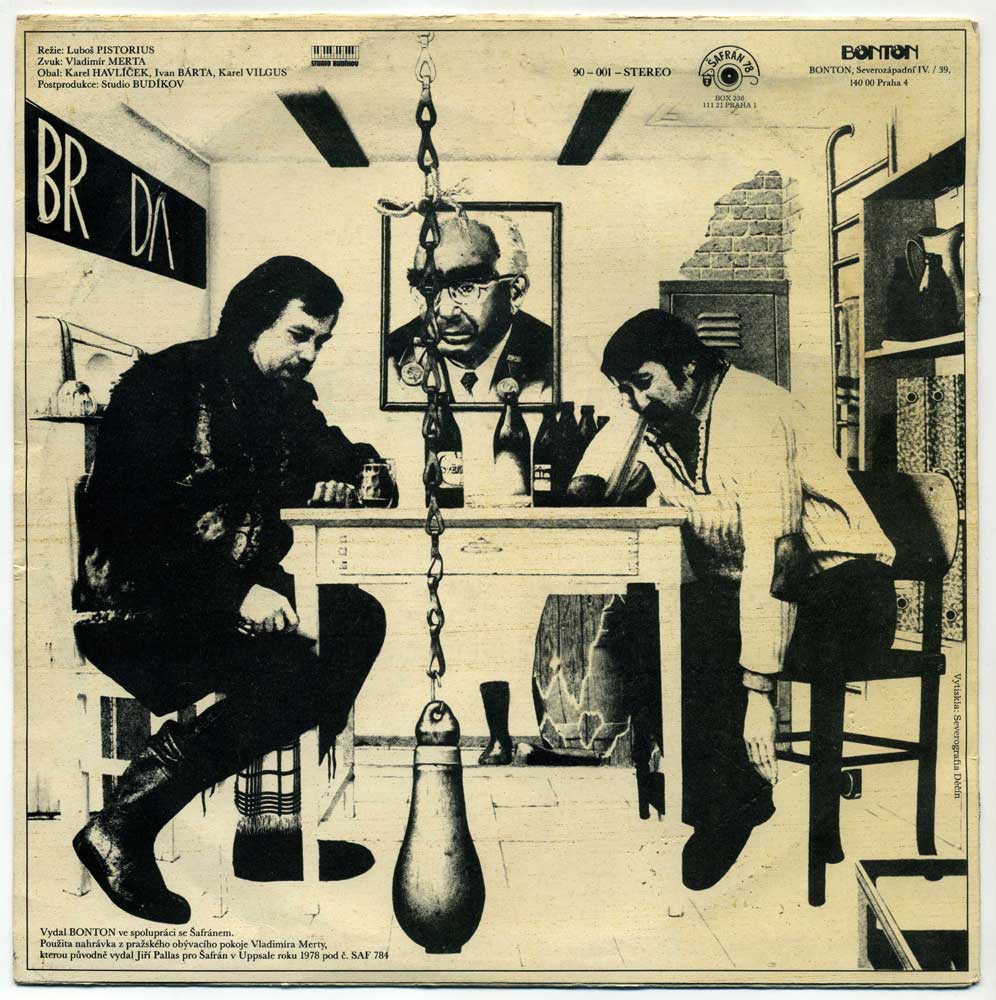
Vaclav Havel was a dissident playwright who became the first President of the Czech Republic. Here is the front and back of a vinyl recording of his play Audience. They are two great images in themselves and could be a stimulus for work. Or maybe they just inspire you to read the play.

David Barnett is Professor of Theatre at the University of York. He works mostly on German theatre, with a particular interest in the Brechtian tradition of making theatre politically. He has written widely on postdramatic and experimental theatre, play texts and directing.
David has developed a wonderful free-to-access resource that connects Brecht’s theories for the theatre to real-world theatre practice. Brecht in Practice is aimed at people who are interested in the political possibilities of theatre-making, who may have read about Brecht and his ideas, but who might find the gap between theory and practice hard to bridge.
The site complements David Barnett’s book, Brecht in Practice, a volume in which many of the theoretical issues are discussed in greater detail.
David has kindly shared a taster of the vast content from Brecht in Practice. This simply scratches the surface of the site and we urge you to follow the links and take full advantage of this fantastic free resource.
Brecht in Practice is rooted in theory but each theoretical idea is connected to real examples in order to show the relationship between theory and practice.
Who was Bertolt Brecht? an overview of Brecht’s life and ideas
Brecht (1898 – 1956) experienced a turbulent world first-hand and sought to understand how such instability could occur and how his approaches to theatre might represent a dynamic, active world that was also capable of change.
The Meaning of ‘Brechtian’: a definition of what this term might mean for theatre practitioners
‘Brechtian’ can be found in all sorts of contexts and applied to all manner of theatre and performance. It is often used to describe certain devices used in performance, such as direct address to an audience, the use of placards or signs, or showing the mechanics of a production instead of hiding them behind illusionist aesthetics. In the light of this, one could describe all manner of TV adverts as ‘Brechtian’, but it is obvious that none of them are concerned with criticizing capitalism or its excesses – on the contrary, they are designed to increase consumption and profits.
I thus propose that ‘Brechtian’ implies the dialectical examination of dramatic material. That is, ‘Brechtian’ puts the emphasis on a method of dealing with dramatic material, not necessarily the means with which the material is performed, even though they are important. While ‘dialectics’ is a philosophical term and has its own vocabulary, the process of dialectical examination is based on the search for socially contextualized contradictions. The theatre company then looks for suitable ways to perform the contradictions in a theatre of showing.
In short, a focus on Brecht’s means rather than his aims can de-politicize the theatre, and make it purely the site of entertaining devices rather than one that engages with society and its mechanisms with a view to changing both.
The Aims of Brechtian Theatre: gives an overall introduction to what Brecht was trying to achieve in his theatre and how he set out his theoretical ideas.
The list of points below is not exhaustive, but does draw attention to some of the more important aspects of Brecht’s theatre.
To stage accurate representations of human beings
To reveal the social factors the influence human action, behaviour and thought
To show the (stage) world as changeable
And derived from these ideas, a Brechtian theatre seeks to:
- Criticize human behaviour, actor and thought as ‘natural’
- Articulate contradictions clearly
Brecht’s Aims for a Production:
Brecht’s Means:
The Brechtian Method: outlines how Brecht’s approach to making theatre can be considered a ‘method’ and how it might be applied.
It begins with the construction of the Fabel , which then leads to initial blockings in the form of the scenes’ Arrangements . The actors then develop a basic Gestus for their figure, and inductive rehearsal leads to a diverse range of Haltungen . The aim, as ever, is to produce lively, realistic theatre that allows the spectator to speculate on the ways society works by drawing attention to the contradictions that drive the action.
A Theatre of Showing: Brecht’s theatre is all about setting out relationships with clarity and not passing over contradictions
Theory and Practice: considers the relationship between the two and offers thoughts on how the two can be negotiated.
Marxism, Dialectics and Contradiction : a more detailed discussion of Brecht’s approach to reality with an emphasis on how the world works and how it can change.
Brecht’s Approach to Reality : this relationship lies at the heart of Brecht’s theatrical ambitions and differentiates his theatre from other forms of theatre-making
Brechtian Realism: contrasts the more conventional definition of ‘realism’ in the theatre with Brecht’s
Politics in a Brechtian Theatre : what are the political implications of Brecht’s theories?
Making Theatre Politically: what is the difference between ‘making political theatre’ or ‘making theatre politically’?
Brecht in Practice presents a virtual modelbook based on a production of Patrick Marber’s Closer.
Click here to access the Virtual Modelbook of Patrick Marber’s Closer.
Brecht in Practice takes an in depth look at a production of Patrick Marber’s Closer staged at the University of York with professional actors in October 2016. The site provides a detailed analysis of the production from the starting point of the theory introduced.
You can download the following exercises:
You can also download the following approaches to working with dramatic material:
Want more on Brecht? Read our interview with Professor Tom Kuhn here.
More music to inspire the imagination.
Judith Malina introduces The Living Theatre:
65 years ago, Julian Beck and I found the Living Theatre, and it continues to do play after play. The Living Theatre is a company of actors who want to bring about the BEAUTIFUL NON-VIOLENT ANARCHIST REVOLUTION. We wanted to find a theatre that would grow with history and in history.
That is why we called it the LIVING THEATRE, because we wanted it to change with time. People say ‘Yeah—the world is in lousy shape, and there are wars and horrors going on all the time. But what am I gonna do? Who am I? What can I do?’
And to give people the sense that there is something they can do, that they are empowered.
That begins in the theatre.
The Living Theatre’s mission by Julien Beck
To call into question
who we are to each other in the social environment of the theatre,
to undo the knots that lead to misery,
to spread ourselves
across the public’s table
like platters at a banquet,
to set ourselves in motion
like a vortex that pulls the
spectator into action,
to fire the body’s secret engines,
to pass through the prism
and come out a rainbow,
to insist that what happens in the jails matters,
to cry “Not in my name!”
at the hour of execution,
to move from the theater to the street and from the street to the theater.
This is what The Living Theatre does today.
It is what it has always done.
“By turns lyrical and earthy, sentimental and ironic, Yuan drama spans a broad emotional, linguistic, and stylistic range. Combining sung arias with declaimed verses and doggerels, dialogues and mime, and jokes and acrobatic feats, Yuan drama formed a vital part of China’s culture of performance and entertainment in the thirteenth and fourteenth centuries.”
In order to understand Yuan drama we must understand the society in which it developed. Yuan society was unique in Chinese history : the entire nation was ruled by a foreign and militant tribe and its people officially divided into four ethnic groups with the Chinese at the bottom. The Mongols were the ruling class ; next were the se-mu, Moslems, Central Asians, Europeans, and other ethnic groups of the western regions ; third the han tribes of the north such as Tatars and Koreans, and those Chinese who lived in the territory of the former Chin dynasty; and lowest of all the Southerners i.e. the Chinese of the now defunct Southern Sung dynasty. These groups formed the basis for discriminatory policies and the practice of a spoils system.
Yang, R. (1958). THE SOCIAL BACKGROUND OF THE YÜAN DRAMA. Monumenta Serica, 17, 333.
The rise of the drama during the Yuan period, has been attributed to various causes. Some scholars believe it was a direct result of the examinations which required skill in composing songs. This theory has been challenged by modern scholars, among whom Wang Kuo-wei:
“The abolition of the examination was the real reason for the development of the drama. Since T’ang and Sung competitive scholars had been accustomed to the examinations. When the examinations were suddenly abolished the scholars no longer had an outlet for their talents; hence they turned their energies whole-heartedly to (the composition of) dramatical arias. Moreover, the requirement for the examinations on subjects during the Chin period had been most simple and shallow. These scholars once they lost what they were used to do, were unable to contribute much to other works of scholarship. For serious essays and documentary writings were not what they were familiar with. At this moment, the new style of drama appeared, and many turned their attention to it. When one or two gifted scholars devoted their entire talents to this new style, the writings of Yuan drama became a unique achievement.”
A third theory is advanced by Shionoya On:
“The Chinese people had always held the teachings of Con- fucius in high esteem, and Confucianism had been regarded as the foundation of both government and religion. But neither the Chin (Tatars) nor the Yuan (Mongols), conquerors who arose from the north, were capable of understand- ing and appreciating Confucian teachings and they allowed considerable freedom of thought in all religions, Confucianism, Taoism, Buddhism, Islam, and Christianity alike. The Chinese people, humiliated by the rule of foreign tribes, sought com- fort and consolation in poetry and wine. They took great delight in the newly developed form through which they could express their indignation against their own oppressors by poking fun at characters of the past. They criticised their world with passion and through satire admonished the people. Those who heard generally developed a sense of sympathy and satisfaction.”
Yang, R. (1958). THE SOCIAL BACKGROUND OF THE YÜAN DRAMA. Monumenta Serica, 17, 332 – 333
In 1995, Grant Shen directed Freed by a Flirt, the world’s first zaju opera in English. In translating the Chinese libretto into English, he preserved as many stylistic features of zaju as possible.
Read more articles by Grant Shen here.
Two English versions of The West Wing. Introduction taken from The Octant.
For a Yuan dynasty (1271-1368) opera, The West Wing (西厢记), written by Wang Shifu, is surprisingly racy, making it the most-performed, as well as the most-banned play in the history of Chinese opera. Now, a group of Yale-NUS College students are staging several scenes from this classic, marking the first time since the mid-Ming dynasty that parts of the original Yuan text are being performed. A separate cast will be performing the English translation of the play.
The West Wing tells the story between two lovers, Oriole and Zhang Sheng, who consummate their love despite parental disapproval. It was deemed immoral, pornographic even, by Confucian scholars and hence was banned for a long period of time in China.
Chinese version of The West Wing
Inspired by National Poetry Day 2017 here are some spoken word poems to stimulate you.
More music to inspire the imagination.


