Essential Videos on Devising: Part 2

We are going to continue to mine the internet for brilliant videos on the topic of devising. This week we are going to focus on The Builders Association.

The Builders Association, an award-winning intermedia performance company founded in 1994, develops its work in extended collaborations with artists and designers, working through performance, video, architecture, sound, and text to integrate live performance with other media. Its work is not only cross-media but cross-genre — fiction and nonfiction, unorthodox retellings of classic tales and multimedia stagings of contemporary events. This book offers a generously illustrated history and critical appraisal of The Builders Association, written by Shannon Jackson, a leading theater scholar, and Marianne Weems, the founder and artistic director of the company.

Andy Lavender’s chapter in Making Contemporary Theatre edited by Jen Harvie and Andy Lavender offers insight into The Builders Association’s rehearsal processes.


Continuous City

CONTINUOUS CITY is a meditation on how contemporary experiences of location and dislocation stretch us to the maximum as our “networked selves” occupy multiple locations. From Shanghai to Los Angeles, Toronto to Mexico City, CONTINUOUS CITY tells the story of a traveling father and his daughter at home tethered and transformed by speed, hypermodernity, and failing cell phones. The characters they interact with pursue their own transnational business, from an internet mogul exploiting networking across the developing world to a nanny who blogs humorous stories about the people and places within her universe. (Read her blog here.)

These excerpts from CONTINUOUS CITY were shot during a performance at BAM in 2008. They show scenes that reflect the production’s themes of disconnect and distance that can be created by the same technology we use to remain connected. In the first scene, performer Rizwan Mirza negotiates his relationship with an online date who threatens to become real. In the second, a traveling father (Harry Sinclair) talks remotely with his daughter (Olivia Timothee). The excerpt also highlights the use of the multiple screens that were employed as part of this production. Austin Switser, who will be designing video for ROAD TRIP, was the assistant on this production.

CONTINUOUS CITY from The Builders Association on Vimeo.

Super Vision

Conceived and created by The Builders Association & dbox.

SUPER VISION explores the changing nature of our relationship to living in a post-private society, where personal electronic information is constantly collected and distributed. The data files collected on us circulate like extra bodies, and these “data bodies” carry stains that are harder to clean than mud or sin; from birth certificates to bad credit, every moment of activity contributes to the construction of one’s own data body.

In this scene recorded during a performance at BAM, an international traveler (Rizwan Mirza) attempts to cross the border into the US. As he is questioned by a border control agent (Joseph Silovsky) his medical data is progressively revealed and superimposed over his physical body. At a time when people were just becoming aware of internet privacy issues, Super Vision explored the increasing ways in which our personal information might be collected and distributed.

SUPER VISION (1) – data body from The Builders Association on Vimeo.

Also recorded at BAM, in this scene a father (David Pence) is in the process of manipulating aspects of his young son’s identity (Owen Pence). This scene also illustrates the way the Builders use recorded images and video that intersect and interact with the live performer on stage.

SUPER VISION (2) – Dad from The Builders Association on Vimeo.

Sontag: Reborn

Adapted from Susan Sontag’s early journals by performer Moe Angelos, SONTAG: REBORN traces Sontag’s private life from the age of 14 to her emergence as a world-renowned author and activist. The young Sontag wrestles with her emerging sexuality and precocious intelligence, fraught with doubt and insecurity yet driven by her willfulness, ambition and voracious curiosity. The refuge of her diary became integral to her development as a writer, Sontag says herself, “In the journal I do not just express myself more openly than I could in person. I create myself.”

Directed by Marianne Weems and using The Builders Association’s signature synthesis of poetic video and sound, this tightly-crafted story of self-discovery and sexual identity is both exuberant and intimate, exploring the private life, loves and idiosyncrasies of the iconic intellectual.

This excerpt from REBORN is included as another example of the immersive use of video and the interaction between live performance and recorded. Younger Sontag is portrayed by performer Moe Angelos on the stage as the same performer recorded on video as older Susan reacts and responds to her early journal writings.

SONTAG: REBORN – Excerpt from The Builders Association on Vimeo.

House / Divided

Using John Steinbeck’s classic novel The Grapes of Wrath as a narrative backbone, HOUSE / DIVIDED (formerly ROAD TRIP) tells contemporary tales of foreclosure, following economic refugees and migrants from two different American eras. Steinbeck’s Joad family moves along the great Dust Bowl migration, while a contemporary house rooted to its site — yet connected to a web of global finance and investment – becomes a container for stories from the current, evolving crisis. HOUSE / DIVIDED explores the changing meaning of home, homelessness, and place both in the present moment and in the broader context of the American mythos.

This excerpt from the beginning of the piece establishes the construct used to move between the two worlds. It also highlights the different ways that media is used to tell the story, from the construction of the house itself to interviews with people affected by and involved in the crisis.

HOUSE / DIVIDED – Excerpt, Wexner (2011) from The Builders Association on Vimeo.

HOUSE / DIVIDED (Excerpt) 2012 from The Builders Association on Vimeo.

Elements of Oz

ELEMENTS OF OZ draws on one of the richest examples of escapist American entertainment, The Wizard of Oz. We revel in the multiplicity of interpretations of this iconic example of popular culture, and examine how tens of thousands of people across the country (and across the globe) have made Oz their own. Through the use of YouTube tributes, a re-contextualization of the film, and the incorporation of new technologies, ELEMENTS OF OZ celebrates and deconstructs this incredibly rich cultural artifact.

ELEMENTS OF OZ: Trailer from The Builders Association on Vimeo.

World Theatre Traditions – Butoh

Extract from A Short Introduction to Butoh by Frances Barbe

So what traits might we consider to be ‘butoh’? A definitive description would never satisfy the breadth of artists involved in it, but a few recurrent themes are useful by way of introduction. Butoh is an attempt to uncover the dance that already exists, it must emerge from within, and not be imposed from without. Butoh uses ‘reduction’ to great effect, for example, stillness and slow motion are well known to audiences of Butoh. Done well, highly charged stillness and very embodied slow motion can heighten the awareness of the dancer and their audience to the detail of movement, and it can explore timeframes beyond the everyday. Reduction or distillation heightens presence, though stillness and slow motion themselves do not account for the absolute presence associated with butoh. Often observed as a kind of ‘trance’, it is more accurate to say the butoh dancer is in a state of ‘hyper-presence’, aware of everything going on around them and within their own body. The fact that butoh dancers often seem ‘other’ than themselves is the result of their skills in transformation.

The two original founders of butoh, Kazuo Ohno and Tatsumi Hijikata offer seemingly contradictory advice on the process of transformation. Ohno might say, ‘find the spirit, and form will take care of itself’. Hijikata might say, ‘find the architecture of the cat, and the spirit will enter’. They approach the same point from different perspectives. Another distinctive aspect of transformation in butoh is that performers don’t necessarily use only human characters as a source. Equally ready to explore transforming into a stone or a wet rug the butoh dancer draws on the full range of textures available in the natural world and attempt to manifest those physical and psychic materials in their bodies. Yoko Ashikawa, one of the earliest female exponents of butoh, danced a tree enduring the changing seasons. For the audience though, her body can become an old woman or their grandmother reliving all of life’s experiences. To think of an old woman is not necessarily the best way to transform into old woman.

Extract from Kazuo Ohno Doesn’t Commute: An Interview with Kazuo Ohno by Richard Schechner

Kazuo Ohno on how he makes the movements:

My mother was my director. She was the one I thought about. The movement motifs of My Mother came from what I thought I was doing in my mother’s womb. I was in her-what was I doing there? Then came the costume-how to wear the costume. I feel that the costume is the cosmos. I must wear the cosmos and move within it. The other motif is cats. I studied their movements and looked at pictures of them. Even in pictures you get a certain kind of movement.

Extract from Hijikata Tatsumi: The Words of Butoh by Kurihara Nanako 

Kurihara Nanako on Butoh lessons with Ashikawa Yōko, a leading disciple of Hijikata Tatsumi.

In Ashikawa’s class, there were routine basic exercises. One of them was called mushikui (insect bites). A student is first told, “An insect is crawling from between your index finger and middle finger onto the back of your hand and then on to your lower arm and up to your upper arm.” The teacher rubs a drumstick back and forth across a drum, making a slithering sound. Then she touches those particular parts of the body to give some physical sense to the student. The number of insects increases one by one and finally, “You have no purpose. In the end, you are eaten by insects who enter through all the pores of your body, and your body becomes hollow like a stuffed animal.” Each insect has to be in its precise place. One should not confuse or generalize the insects even when their numbers increase. The most difficult part of this exercise was that one had to “be it,” not merely “imagine it.” This was emphasized in the class again and again. The condition of the body itself has to be changed. Through words, Hijikata’s method makes dancers conscious of their physiological senses and teaches them to objectify their bodies. Dancers can then “reconstruct” their bodies as material things in the world and even as concepts.’ By practicing the exercises repeatedly, dancers learn to manipulate their own bodies physiologically and psychologically. As a result, butoh dancers can transform themselves into everything from a wet rug to a sky and can even embody the universe, theoretically speaking.

Butoh Documentary – Piercing the Mask

Using contemporary footage of leading Butoh performers, this documentary presents the history of the development of butoh dance, interviews the creator of this Japanese modern dance form, Tatsumi Hijikata and other artists and explores the cultural significance of the Butoh dance form in Japan.

Butoh in Europe

This is a six part documentary of two weeks of workshops and performances exploring European interpretations of the Japanese movement form Butoh held at schloss Bröllin in Mecklenburg-Vorpommern, North East Germany in the long hot summer of 1995.


Midweek Mixtape 3

This week’s mixtape is inspired by Akala and hip hop music. The TEDx talk serves as an introduction to the song selections.

Akala demonstrates and explores the connections between Shakespeare and Hip-Hop, and the wider cultural debate around language and it’s power.

Essential Videos on Devising: Part 1

This week we take a look at a range of ‘devising’ theatre companies. We have used the companies featured in The Contemporary Ensemble: Interviews with Theatre-Makers edited by Duška Radosavljević and Devising in Process edited by Alex Mermikides and Jackie Smart. This can be a visual accompaniment to these fantastic books.


Song of the Goat

In this interview Grzegorz Bral director of Song of the Goat Theatre and LSPAP talks about London School of Performing Arts Practices, Brave festival, coordination technique and his approach to theatre and performing arts.

The Riot Group

SOPHIE GETS THE HORNS

By Adriano Shaplin

Directed by Rebecca Wright

Performed by Kristen Bailey, Drew Friedman, Adriano Shaplin, Mary Tuomanen, Stephanie Viola

Set by Caitlin Lainoff / Lights by Maria Shaplin / Costumes by Katherine Fritz / Sound by Adriano Shaplin

Performed at Incubator Arts Project, May 2012, NYC

“Delicately hilarious…a clear-eyed ethnography of our own species at a specific developmental stage…the ensemble seems exquisitely tuned to a difficult chord of poignancy and awkwardness.” –Time Out

SOPHIE 5-18-12 MASTER H264 1280×720 from The Riot Group on Vimeo.

FREEDOM CLUB

By Adriano Shaplin

Directed by Whit MacLaughlin

Performed by Drew Friedman, McKenna Kerrigan, Jeb Kreager, Mary McCool, Paul Schnabel, Adriano Shaplin, Stephanie Viola

Lights Maria Shaplin / Costumes Rosemarie McKelvey / Sound Whit MacLaughlin / Projection Design Jorge Cousineau / Production Stage Manager Emily Rea / Executive Producer: New Paradise Laboratories

Freedom Club was made possible with the support of Princeton University, Drexel University, the Off-Center for Dramatic Arts, the Pew Center for Arts & Heritage through the Philadelphia Theatre Initiative, and the National Endowment for the Arts.

“Epic theatre…possessing a unique, violent, and total language, at once written, spoken, and played.” –CultureBot

“In Freedom Club the darker underpinnings of human liberty are considered with a grim cackle.” –The New York Times

“A daring mashup by two experimental companies (Philadelphia’s New Paradise Laboratories and New York’s the Riot Group) and two eras (1865 and 2015), “Freedom Club” indicts fanatical radicalism in America. Aptly self-described as “a hallucination on national themes,” the satire vividly skewers self-aggrandizing extremists from John Wilkes Booth to a feminist collective that spawns another presidential assassin.” -Variety

Freedom Club from The Riot Group on Vimeo.

The Neo-Futurists

A short documentary about The Neo-Futurists and their long running late night show Too Much Light Makes The Baby Go Blind. Contains clips from the show and interviews with, Jay Torrence, Heather Riordan, Caitlin Stainken, Greg Allen and others. The Neo-Futurist are a Chicago based theater company who produce the longest running show in Chicago, T.M.L.M.T.B.G.B. (30 plays in 60 minutes) , as well as a full season of original primetime shows.

Ontroerend Goed

History oktober 2014 deel 2 from Ontroerend Goed on Vimeo.

ALL THAT IS WRONG – FULL PLAY from Ontroerend Goed on Vimeo.

Tom Nicholas caught Ontroerend Goed’s £¥€$ (or Lies) at the Drum Theatre this week ahead of its transfer to Summerhall and the Edinburgh Festival Fringe. This interactive piece by the Belgian provocateurs sees the theatre transformed into a casino and audiences into freewheeling free market capitalists. Here’s Tom’s performance analysis of the show.

Tom is an exciting theatre vlogger putting out interesting new videos every week discussing theatre and playwriting from the perspective of an aspirant and (some might say) emerging playwright, theatre maker and academic. Support this fantastic tool with a subscription.

Twitter: @Tom_Nicholas

Website: www.tomnicholas.com

The People Show

People Show 121: The Detective Show from People Show on Vimeo.

Station House Opera

Julian Maynard Smith is the founder and artistic director of Station House Opera. Founded in 1978, Station House Opera creates solo and group performance work as well as sculpture and installation. Dissolved is the company’s first new work since the city scale site specific project Dominoes in 2009 and follows earlier intercontinental performances developed as far back as 2004. Their distinctive engagement with audiences crosses new boundaries with an installation and performance that uses live video streaming to dissolve spaces in London and Berlin, bringing people from both cities into dynamic connection.

dissolved (extract) from julian maynard smith on Vimeo.

Station House Opera – Snakes and Ladders from julian maynard smith on Vimeo.

Station House Opera – Mind Out from julian maynard smith on Vimeo.

Theatre O

This is Theatre O’s vision statement. Rather than just have something written down on a piece of paper, they thought it would better to reflect how they approach work by making something a little more visual. They worked with animator and long term collaborator, Paddy Molloy, who made a stop frame animation of the creation and destruction of a drawing he made based on our previous work.

Vision from theatre O on Vimeo.

Delirium Trailer from theatre O on Vimeo.

The Argument – Car Crash from theatre O on Vimeo.

The Argument – On Old Age from theatre O on Vimeo.

Gecko

Gecko Compilation 2015 from Gecko Theatre on Vimeo.

About Gecko | Education from Gecko Theatre on Vimeo.

Amit FAQs | Education | Gecko from Gecko Theatre on Vimeo.

FAQs for a Gecko Performer | Education | Gecko from Gecko Theatre on Vimeo.

Third Angel

Third Angel have always worked with rules when making shows, and they’ve always enjoyed the creativity that those restrictions give us – as well as enjoying the moment when you realise that the rules need to be broken. Popcorn is a performance for both camera and live audience reflecting on rules, time, making stuff, shared language, shared history and friendship. Performed and filmed on location at The Holt cafe and art-space, Sheffield.

Third Angel: POPCORN from Third Angel on Vimeo.

World Theatre Traditions – Rakugo

Extracts from Rakugo: Popular Narrative Art of The Grotesque by Sasaki Miyoko and Morioka Heinz

“Although many stories have been adapted from written sources. rakugo can be considered a genuine form of oral art because its principal route of transmission down to us has been through the lips of the performers. To this day there are no written manuals or librettos containing the full text of a performance or of the way a story has to be presented. There is mainly oral transmission from master to pupil. Written notes to help in memorization or tape recordings are frowned upon. Through long years of personal association with his teacher, listening to his performance from backstage, and living as an apprentice in his home, the student devotes his attention to mastering the stories.”

“The sense of reality is maintained throughout the story, and shared by performer and audience alike. Drawing freely on his personal experience, the performer styles his own individual pre- amble or “pillow” (makura t) for his story, selecting among con- temporary events, the weather, or work, whatever topics he feels his audience might be interested in. When he enters into the story itself, then his hero, in a curious and sudden shift of time dimen- sion, leaps out of the setting of an old tale right into the present moment and confronts the audience. Here, if the storyteller clumsily tries to evoke laughter in an obvious way, the effect will amount to nothing more than crowd-pleasing titillation, and his story may fall flat. But the expert performer can bridge the time gap smoothly and without a hitch, drawing the audience along with him into the world of classical rakugo.”

“The rakugo performer must organize his story in a new way each time, but if he is to remain within the confines of classical tradition, he is forced to observe certain definite rules. Throughout several centuries of rakugo the main plots of the stories and the heroes’ names have not changed. In the organization and minute descriptive details of episodes, with each performance, each year, and each generation, a great variety of different nuances and changes have appeared. No story can ever be performed twice in exactly the same way.”

“Changes in scene of a story are described by onomatopoetic words and sounds; for example, the ringing of a temple-bell, bon-bon; the clatter of wooden clogs, karan-koron; the sound of the wind, pyiu u u u; rolling of stones, gara-gara; or noise in the background, di-di, go-go. Onomatopoetic insertions can extend over a period of more than one minute, when they describe such movements as slow walking, tata tata…, tsun tsun …; running, sai-sai koro-sai, e-sa-sa, sowa- sowa, chowa-chowa; walking with heavy baggage on one’s shoulders, wasshoi-wasshoi…, or the sounds of work and play, kachi-kachi, pachi-pachi, pochi-pochi, poka-poka, potsu-potsu, sara-sara; or heavy exertion, hora-yo, sora-yo,yosshoi.”

“The rakugo performer is not supposed to change his position once he takes a seat on the stage. But merely by the movement of the upper half of his body he represents all kinds of actions. Walking from one place to another is expressed by one of the most amusing gesture formulas of rakugo: the performer withdraws his hands into the wide sleeves of his kimono, his knees, hips, and shoulders sway rhythmically, and he talks to himself in a murmuring voice, as if lost in thought. The audience knows that a person is on his way to an- other place; they also know that he will suddenly be startled out of his thoughts by an unexpected event, and they anxiously wait for that moment.”

“The focal point of the rakugo story is the world of everyday. Many of its cast of characters strut about dressed in sundry garb and historical costumes, but they are part of the storyteller’s world and the world of his audience. From there the rakugo performer takes the models which he fits into various stereotypes according to class and profession: the feudal lord, the military man, the priest, the scholar, the retired head of the house, the working-class man, the farmer. At times the principal characters are complete outsiders that do not fit into ordinary societal roles: the cheapskate, the thief, the liar, or the prostitute. Sometimes it is just the simpleton, the lazy- bones, the miser, the boozer, and the conniver that pass across the imaginary rakugo stage. There are, of course, no detailed portrayals of people as individuals. This is the major difference between rakugo and pure literature. While there are instances where a character is provided with a definite personality, there are practically no examples of that personality changing as the story develops.”

Miyoko, S., & Heinz, M. (1981). Rakugo: Popular Narrative Art of The Grotesque. Harvard Journal of Asiatic Studies, 41(2), 417-459. doi:10.2307/2719050

Essential Stimuli 2

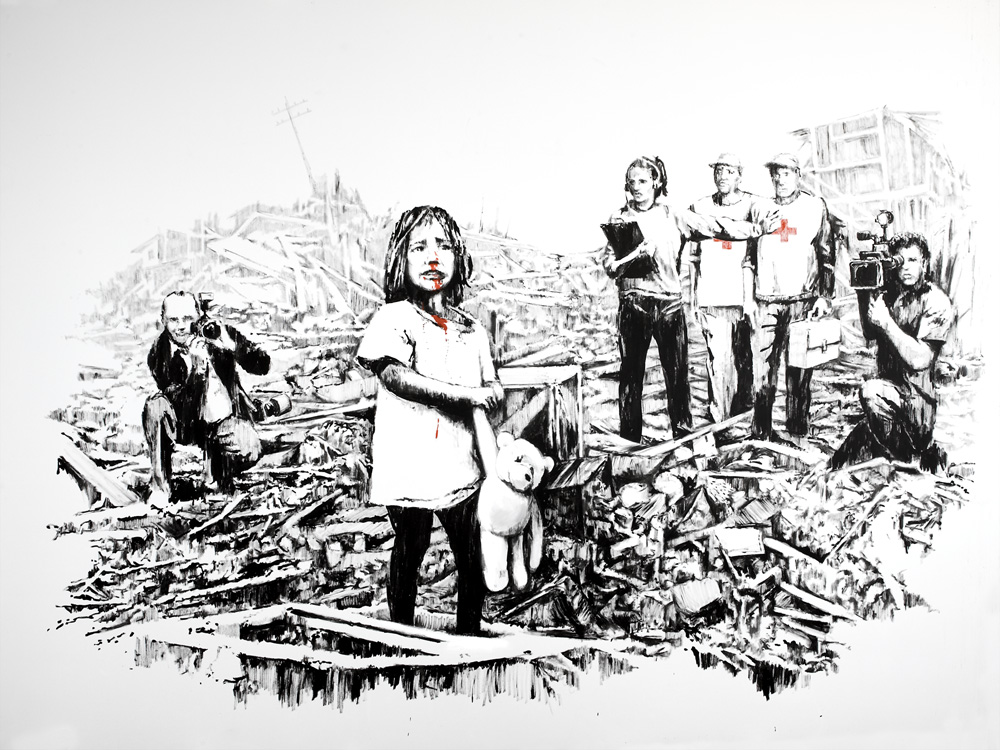
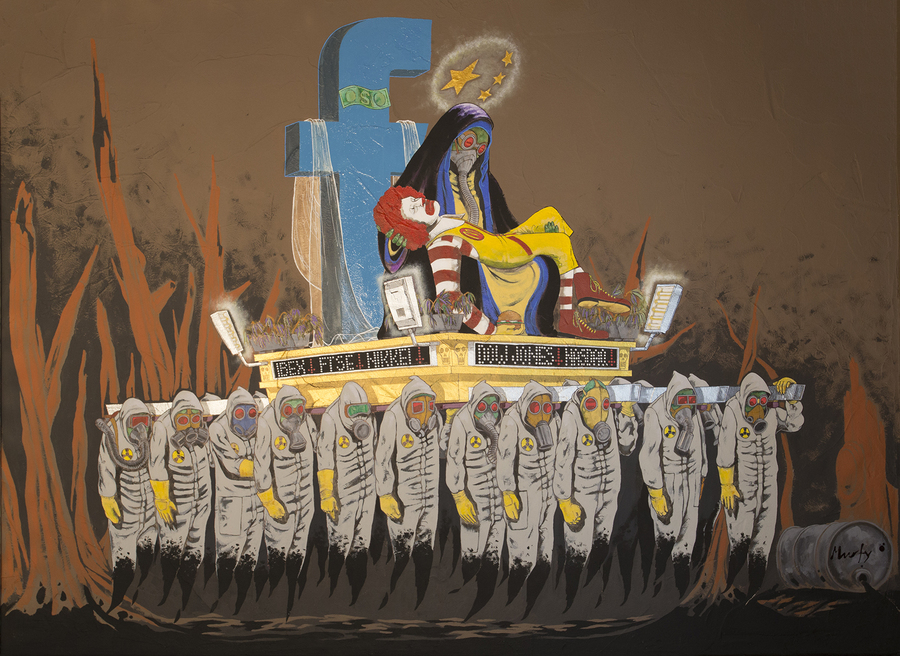
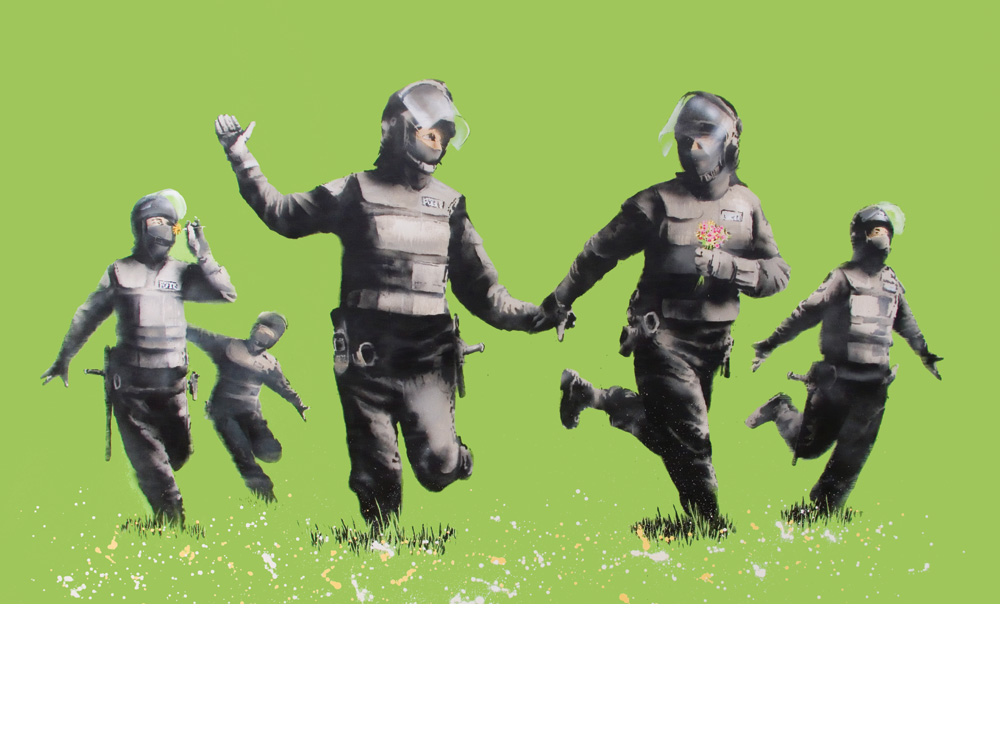
Here is a selection of street art to raise questions and encourage discussion.

media – banksy

The Holy Chemical Picture Show – murfy

It must be the abs – Igordobrowolski

Friends – ill
Riotcops – banksy

Essential Videos on Movement

This weeks video resources focus on movement. Here is a selection of video content from around the web. There is the full spectrum here, from abstract dance to more naturalistic theatre. Some are training masterclasses and some are performances. I hope each can serve as an inspiration for your own creativity.

PLEASE NOTE: Not all movement exercises are suitable for everyone and this or any other movement exercise may result in injury. To reduce the risk of injury, never force or strain, use the exercises only as intended and demonstrated, and follow all instructions carefully.

A Eurhythmics introduction and demonstration with Lisa Parker, director of the Dalcroze Eurhythmics program at the Longy School of Music in Cambridge, MA. Lisa discusses Eurhythmics, its goals and benefits through a lesson on measure shape.

In the 1990’s, after the opening of archives in the former Soviet Union, an original source of Biomechanics became known. Nikolai Kustow, the Biomechanics instructor in Meyerhold’s Theater, maintained a “hidden” school and secretly passed on principles and etudes to a new generation of actors. In this video, Russian actor and pedagogue, Gennadi Bogdanov is shown presenting the most important etudes and principles of Biomechanics. In addition to historical film and photodocumentation of Biomechanics, the video also displays recent scenic work from Europe and the USA developed from the basis of Meyerhold’s Biomechanics. In English, 43 mins, colour & Black & white.

Gennadi Bogdanov demonstrates a Biomechanics study created by Meyerhold. Then he applies the work to a study of Lucky’s monologue in Waiting for Godot.

The study of Meyerhold’s ‘Throwing the Stone’. This video shows a demonstration of Meyerhold’s study by Ralf Réuker, student of Gennadi Bogdanov, and analyzed by Eugenio Barba. It was taken during a series of lectures organized in 1997 by the Center for Performance Research in Aberystwyth, Wales. During the demonstration Barba sometimes addresses the audience and in Ralph, the student of Biomechanics.

Revolutionary dancer and choreographer Mary Wigman introduces some of her work.

Martha Graham discusses her craft in A Dancer’s World.

Choreographer Merce Cunningham took chances. Over a seven decade career, his explorations reshaped dance into a new kind of art form, deeply influencing visual art, film, and music along the way. Through experimental collaborations with John Cage, Robert Rauschenberg, Marcel Duchamp, and others, he became the 20th century’s most influential choreographer. In conjunction with the exhibition Merce Cunningham: Common Time, we look at the many sides of Cunningham: dance maker, collaborator, chance-taker, innovator, film producer, and teacher.

In the spring of 1981, during a residency at the Walker Art Center in Minneapolis, Minnesota, choreographer Merce Cunningham and composer John Cage sat down to discuss their work and artistic process. As frequent collaborators, Cage and Cunningham pioneered a new framework of performance. Their novel approach allowed for mediums to exist independently, or rather cohabitate, within a performance, thus abandoning the co-dependent model of dance and music. Cage and Cunningham go on to discuss the methodology and motivations behind chance operations, a term used to describe artistic decisions based on unpredictability. Wanting to free himself of his likes and dislikes, Cage describes how Zen Buddhism influenced his work, leading him to use tools of chance. These new methods, adopted by both Cunningham and Cage, overturned a whole foundation of thought around music, movement, and the process of creating art.

Taken from a television special called The Body Speaks, Ryszard Cieslak of Grotowski’s Laboratory briefly speaking and then presenting some exercises in the Plastiques and Corporals with two Danish students.


We all use our body on a daily basis, and yet few of us think about our physicality the way Wayne McGregor does. He demonstrates how a choreographer communicates ideas to an audience, working with two dancers to build phrases of dance, live and unscripted, on the TEDGlobal stage.

Wayne McGregor is well known for his physically testing choreography and ground-breaking collaborations across dance, film, music, visual art, technology and science. In 2000, he and his company Wayne McGregor | Random Dance embarked on a series of projects investigating aspects of creativity in dance with researchers from other fields such as cognitive and social science.

A series of systems developed for choreographers to engage more fully the imaginations of performers tasked with generating new movement material.

Spring Dance 2011 hosted the world premiere of DV8’s newest work Can We Talk About This? The performance deals with freedom of speech, censorship and Islam using real life interviews and archive footage to examine influences on multicultural policies, press freedom and artistic censorship. Australian Lloyd Newson conceived and directed the work and founded DV8 in 1986.

The clip starts at a monologue with hand choreography that is particularly interesting.

Masterclass with Akram Khan including interviews

Follow Akram Khan for a day

Clip from Zero Degrees – ‘zero degrees is the reference point where everything begins…and everything ends’. Akram Khan

zero degrees, Akram Khan Company from Akram Khan Company on Vimeo.

In order to help students and teachers who wish to use Hofesh’s work as a stimulus to perform a solo in the style of a specified practitioner, Hofesh and the company offer this short film resource and accompanying study notes which can be downloaded here: http://hofesh-media.s3-eu-west-1.amaz… In this resource Hofesh shares an extract from his 2010 work Political Mother, which he feels best encapsulates his movement style. This extract is danced by company member Chien-Ming Chang (known to us all as Ming) who was an original cast member of Political Mother.

Maze is an immersive new performance presented by Jasmin Vardimon Company and Turner Contemporary, choreographed by critically-acclaimed director Jasmin Vardimon, in collaboration with Ron Arad and artist Guy Bar-Amotz. This film gives an incredible insight into Jasmin’s creation process for both the structure and the performance. It provides a deeper look at the working methods of her company, and how they’ve been adapted to the unique new environment, and exploring some of the motivations and challenges encountered.

Jasmin Vardimon Company Repertoire

Gecko has fantastic video resources with many of their full shows available here. I have chosen The Time of Your Life that was developed specifically as a piece of filmed theatre. It is a great introduction to their work.

Vanessa Ewan leads this movement direction masterclass, guiding an actor playing Nora from A Doll’s House using techniques to explore physicality and enhance character transformation.

Ever wondered what a Movement Director does? In this short film we hear from Movement Directors Joseph Alford, Kate Flatt, Imogen Knight and Diane Alison-Mitchell explaining their role in a production, the key differences between movement direction and choreography and how movement develops its own theatrical language in performance.


World Theatre Traditions – Kathakali

Eugenio Barba introducing Kathakali

On the southern coast of India, the three-hundred-year-old Kathakali ritual theatre still flourishes, a mixture of dance and pantomime, religious inspiration and mythological tradition.

The plays describe extraordinary events involving gods, demons, and legendary characters. They all have one common characteristic: good and the gods always triumph over evil and the demons. The actor acts out the struggle between good and evil exclusively through the motions of his body, and the subjects of the plays are as well known to the audience as the myths of the Greek trilogies were to the Athenians.

Through his gestures and his mimicry, the Kathakali actor recreates the atmosphere and the action of the drama while describing to the audience the action’s locale. His technique is much closer to the Chinese opera than to the European mime or ballet, which tells a story through a direct or “exoteric” technique. In the Oriental ballet, on the contrary, a cipher is used. Each gesture, each little motion is an ideogram which writes out the story and can be understood only if its conventional meaning is known. The spectator must learn the language, or rather the alphabet of the language, to understand-what the actor is saying. This alphabet of signs is complex. There are nine motions of the head, eleven ways of casting a glance, six motions of the eyebrows, four positions of the neck. The sixty-four motions of the limbs cover the movements of the feet, toes, heels, ankles, waist, hips-in short, all the flexible parts of the body. The gestures of the hands and fingers have a narrative function and they are organized in a system of fixed figures called mudras (“signs” in Sanskrit). Those mudras are the alphabet of the acting “language.”

The face expresses the emotions of the actor. If he is terror-struck, he raises one eyebrow, then the other, opens his eyes wide, moves his eyeballs lathis nostrils flare out, his cheeks tremble and his head revolves in jerky motions. To express paroxysmal rage, his eyebrows quiver, his lower eyelids rise on his eyes, his gaze becomes fixed and penetrating, his nostrils and lips tremble, his jaws are clamped tight, and he stops breathing to bring about a change in his physiognomy. There are sets of facial motions to express not only feelings and emotions, but traits of character of a more permanent nature, such as generosity, pride, curiosity, anxiety in the face of death, etc. However, the actor does not rely exclusively on prearranged mechanical gestures to express emotions. He cannot reach his audience unless his own imagination and motions come into play. The old masters of the Kathakali have a rule which says:

“Where the hands go to represent an action, there must go the eyes; where the eyes go, there must go the mind, and the action pictured by the hands must beget a specific feeling which must be reflected on the actor’s face.”

From this rule we can see that the face is the emotional counterpart of the story told, not by somebody else, but by the actor’s own hands. In short, there is a double structure: the actor must resort simultaneously to two different sets of technique to express the two complementary aspects of a story, the narrative and the emotional. His hands “tell” the former, while his face expresses the latter.

Barba, E., & Sanzenbach, S. (1967). The Kathakali Theatre. The Tulane Drama Review, 11(4), 37-50. doi:10.2307/1125137

Tadg O’Keefe introducing Kathakali

Katahkali Training

Kathakali Facial Expressions

The future of Kathakali?

The BBC’s Megha Mohan went to a now-closed traditional Kathakali school, one that gave birth to its own style, the Kalluvazhi Chitta: http://www.bbc.co.uk/news/av/world-asia-india-35473499/a-rare-performance-of-india-s-kathakali-dance