Littlewood’s Approaches to Texts and Devising

Interview with Nadine Holdsworth: Part 4

Nadine Holdsworth is Professor of Theatre and Performance at the University of Warwick. Her research has two distinct, but sometimes interconnected strands in Twentieth Century popular theatre practitioners and theatre and national identities in England, Scotland, Wales and Northern Ireland. She has worked particularly on Joan Littlewood and has written Joan Littlewood for the Routledge Performance Practitioners Series in 2006 and Joan Littlewood’s Theatre with Cambridge University Press in 2011.

email: n.holdsworth@warwick.ac.uk

Connections to the GCSE, AS and A level specifications

  • Methods of creating, developing, rehearsing and performing
  • Key collaborations with other artists
  • The relationship between actor and audience in theory and practice
  • Influence
  • Significant moments in the development of theory and practice
  • Social, cultural, political and historical context

PC: Is there a clear difference in her work with text compared to her devised pieces?

NH: Yes. The form was always about making it work with the text, so whatever the text required was the form that was made. Or in terms of the more improvised pieces like Oh What a Lovely War or earlier plays like John Bullion it was about the best relationship between the different elements of production. Derek Paget uses a term collision montage which I think is a really lovely way of talking about that work. She constantly reordered scenes making something like Oh What A Lovely War, to see what was going to have the most impact: put that next to that, what does that do? Try it again here, what does that do?

PC: I know that Littlewood was very playful with her actors: was her experimentation with form rooted solely in her playfulness or was it rooted in a research and understanding of the theatre?

NH: I think it changes given the different contexts she was working in.

  • In the beginning the impetus was political
  • then it moved through to wanting to make really vivid theatrical imagery
  • then the idea of the authentic working class voice becomes more important (A Taste of Honey, You Won’t Always Be On Top and Brendan Behan’s plays)
  • Then she shifts into wanting to be much more improvisational, breaking down that relationship between the auditorium and the stage space with interruptions and humour to develop a relationship with the audience.
  • Then after Oh What a Lovely War she gets completely bored with theatre and theatre spaces full stop and she starts doing community projects for kids and makes plans for this big cultural centre – the Fun Palace. This idea lives on in the Fun Palace events run across the world at the start of October led by co-directors Stella Duffy and Sarah-Jane Rawlings.

So yes there is definitely the sense of her anarchic spirit driving these shifts but it is also about her ever growing knowledge of the theatre that never allowed her work to stay still.

Summary

  • Littlewood constantly reordered scenes making something like Oh What A Lovely War, to see what was going to have the most impact. Derek Paget uses a term collision montage.
  • Littlewood’s anarchic spirit drove shifts in her approach but changes always came about with her ever growing knowledge of the theatre.


Littlewood’s Continuous Loop and the Authentic Voice

Interview with Nadine Holdsworth: Part 3

Nadine Holdsworth is Professor of Theatre and Performance at the University of Warwick. Her research has two distinct, but sometimes interconnected strands in Twentieth Century popular theatre practitioners and theatre and national identities in England, Scotland, Wales and Northern Ireland. She has worked particularly on Joan Littlewood and has written Joan Littlewood for the Routledge Performance Practitioners Series in 2006 and Joan Littlewood’s Theatre with Cambridge University Press in 2011.

email: n.holdsworth@warwick.ac.uk

Connections to the GCSE, AS and A level specifications

  • Social, cultural, political and historical context
  • Key collaborations with other artists
  • Influence
  • Methods of creating, developing, rehearsing and performing
  • Theatrical style
  • Innovations
  • The relationship between actor and audience in theory and practice

PC: What was her existence during the Second World War? Did she continue making theatre?

NH: She was making a living by doing lots of radio. There is an early period when she went to Manchester because she’d met a guy called Archie Harding at RADA. He’d come and examined a verse speaking competition that she’d won. So she went off to search for this guy and he offered her work at the BBC. This led to her doing quite a few documentary pieces; most famously a piece called The Classic Soil. She’d go out, again you can see real links with the theatre, she’d go out and interview ordinary people in their ordinary working or living environments and just talk to them. She had a big thing about wanting to hear the authentic working class voice.

PC: How common was the documentary style that presented the authentic working class voice?

NH: Not common at all; it was a really new thing; it was again with Ewan MacColl. We mustn’t underestimate the importance of him in that early period. The two of them were totally in cahoots and developing things. It is worth looking up The Classic Soil.

PC: This search for an authentic voice and specifically an authentic working class voice in Joan Littlewood’s work, along with Erwin Piscator’s Living Newspaper technique and Peter Cheeseman’s Stoke documentaries, are seen as early examples of what has become known as verbatim theatre. Joan’s legacy can be seen in Alecky Blythe’s Little Revolution or Dan Murphy’s new play Carry on Jaywick. Are there examples in her theatre work that were influenced by the radio documentary form?

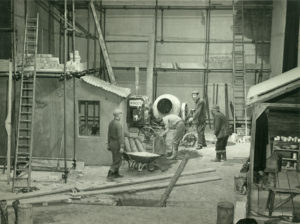
NH: Yeah, I think definitely that idea of presenting the authentic voice is a root of modern verbatim theatre. She felt the authentic working class voice wasn’t being heard on the British stages at that time so it became really important to her. A good example is a play called You Won’t Always Be On Top (Henry Chapman), which was set on a building site. It was one of the plays that she did in the 1950s in which she collaborated very closely with the writer and the script was evolving in rehearsals, which happened a lot with her work. She took all the performers off to a building site and they had to learn how to build a wall because they had to build one in the production every night. She had this incredible replica of a building site on stage. But more important than the visual authenticity, was the focus on patterns in the voice. Joan wanted to have that very real quality of back and forth banter that happens in lots of contexts, but this building site in particular. I think that idea of trying to document and record and authenticate the voice does have a line through to verbatim theatre today.

PC: In terms of records of those things. Is there the play text?

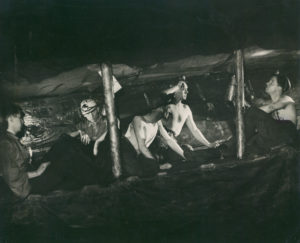
NH: Yes there is the play text of You Won’t Always Be On Top and there are some great photographic images as well. Another is The Long Shift, a play she wrote with Gerry Raffles, who became her partner.

the-long-shiftCourtesy of Theatre Royal Stratford East Archive Collection.
It is about miners down a mine shaft so you see that attempt at visual authenticity there.

This is the set for You Won’t Always Be On Top.

you-wont-always-be-on-topCourtesy of Theatre Royal Stratford East Archive Collection.
You can see she is trying to create a truthful recreation, a very naturalistic looking environment.

PC: She is not usually associated with that style of work.

NH: No but it was a major part of what she did. I think that is one of the things that is really interesting about her: there is no set style. She believed that theatre should always be organic, made in the moment.

PC: The authentic voice seems to be an important debate at the moment, in the theatre and broader society. Theatre is accused of being too London centric, whilst the country, post-EU Referendum, as a whole is suffering a disconnect with working class people, particularly illuminated by the Labour Party’s current identity crisis. So a hypothetical question: How might Joan Littlewood respond to modern Britain in terms of creating her theatre?

NH: She referred to the idea of the continuous loop between the theatre, the audience and the local community. So I think it would be interesting to think about what the Theatre Royal, Stratford East, has become. When Littlewood was there it was a staunchly working class environment predominantly. It is now an incredibly multi-ethnic community and the theatre has evolved to reflect that community. Theatre today, like in Littlewood’s day, is predominantly a white middle class pursuit but at Theatre Royal, Stratford East it absolutely isn’t. It is one of the most diverse audiences and I think that is because they work with that ethos of the continuous loop. You have to go out into the community, find out about the people, who the people are, what their narratives are, what the voices are, what the stories are that they want telling. Then you go back into your theatres and you make that work, you commission it, you make it.

Summary

  • Ewan MacColl was an important part of Joan Littlewood’s life and career in that early period. We mustn’t underestimate the importance of him.
  • Littlewood had a big thing about wanting to hear the authentic working class voice. She’d go out and interview ordinary people in their ordinary working or living environments and just talk to them.
  • The idea of trying to document and record and authenticate the voice does have a line through to verbatim theatre today.
  • You Won’t Always Be On Top and The Long Shift had a set that tried to be a truthful recreation, a very naturalistic looking environment.
  • The continuous loop: you have to go out into the community, find out about the people. Then you go back into your theatres and you make work in response to what you find.

Littlewood’s Context and her Political Convictions

Interview with Nadine Holdsworth: Part 2

Nadine Holdsworth is Professor of Theatre and Performance at the University of Warwick. Her research has two distinct, but sometimes interconnected strands in Twentieth Century popular theatre practitioners and theatre and national identities in England, Scotland, Wales and Northern Ireland. She has worked particularly on Joan Littlewood and has written Joan Littlewood for the Routledge Performance Practitioners Series in 2006 and Joan Littlewood’s Theatre with Cambridge University Press in 2011.

email: n.holdsworth@warwick.ac.uk

Connections to the GCSE, AS and A level specifications

  • Social, cultural, political and historical context
  • Theatrical purpose
  • Innovations
  • Key collaborations with other artists
  • Influence
  • Theatrical style
  • Significant moments in the development of theory and practice
  • Methods of creating, developing, rehearsing and performing

PC: What was most important to Littlewood at the start of her career?

NH: I think it was the political convictions. The fact that she became involved very early on in the 30s with Ewan MacColl and the Workers’ Theatre Movement. She had gone to RADA, left RADA because she couldn’t bare the sterile nature of the theatre that she was expected to do: the “anyone for tennis”, “cup and saucer” theatre which she abhorred. So she’s looking around saying look we’ve got some people here doing hunger marches, we’ve got a general strike, there are people that are in an extreme state of poverty and the theatre of the day is simply not addressing those social, economic, political issues. So that was the galvanising force initially: a real political impetus married with this passion for theatre and how theatre could be a voice for that experience. Theatre offered a way of approaching it, tackling it, investigating it in a way that would also be entertaining. Theatrically, at the same time, she is a real magpie, getting interested in the European theatre traditions. She is one of the early people in Britain, with Ewan MacColl, to start looking at Stanislavski, Piscator and Meyerhold and thinking – “These are great!” – whereas the British theatre tradition was still very much a text heavy theatre – the voice of the ac-TOR speaking. She thought no, there are these people that are doing these incredible theatrical pieces of work that she was really excited about. So I think that initial period was about trying to marry a theatre with a political impetus and an entertaining theatricality. But also about experimenting and how she could be a magpie and pick on all these influences she was seeing from abroad.

PC: What was her first stylistic response to that political impetus?

NH: Mainly that the theatre of her day was not how it should be. She was very much reacting against what she was seeing in the British theatre. As well as the influence of what she was seeing from European practitioners and seeing a theatrical vitality that was exciting for her. I think the first works from the 1930s were quite expressionistic, with short scenes, many of them very visual. You’ve also got this Agitprop movement, the Workers’ Theatre style of theatre, which is out on the streets, pulling on a cart and doing work to people in unemployment queues, queuing up for labour exchange and for jobs. These companies would pull up and do these short sharp topical sketches. They used a visual short hand: the bowler hat or the top hat for the posh blokes and the flat caps for the workers. They were doing scenes that were trying to show the workers’ experience back to them.

PC: She was involved in a few companies. Did she have a company then?

NH: Yeah, the Theatre Union and that worked until the beginning of the Second World War when people went off to fight and then they reformed after the war as Theatre Workshop in 1945.

Summary

  • People were doing hunger marches, there was a general strike, there are people that are in an extreme state of poverty and the theatre of the day was simply not addressing those social, economic, political issues.
  • Theatre offered a way of approaching it, tackling it, investigating it in a way that would also be entertaining.
  • She is one of the early people in Britain, with Ewan MacColl, to start looking at Stanislavski, Piscator and Meyerhold
  • Stylistically she was very much reacting against what she was seeing in the British theatre.

Introducing Joan Littlewood’s ideas

Interview with Nadine Holdsworth: Part 1

Nadine Holdsworth is Professor of Theatre and Performance at the University of Warwick. Her research has two distinct, but sometimes interconnected strands in Twentieth Century popular theatre practitioners and theatre and national identities in England, Scotland, Wales and Northern Ireland. She has worked particularly on Joan Littlewood and has written Joan Littlewood for the Routledge Performance Practitioners Series in 2006 and Joan Littlewood’s Theatre with Cambridge University Press in 2011 http://www.amazon.co.uk/dp/1107532043.

email: n.holdsworth@warwick.ac.uk


Connections to the GCSE, AS and A level specifications

  • Social, cultural, political and historical context
  • Theatrical purpose
  • Innovations
  • Key collaborations with other artists

PC: There are only a few working on the historic and academic study of Joan Littlewood: yourself, Robert Leach, Wendy Richardson and her documentary series In the Company of Joan, Tom Cornford doing research into Theatre Workshop at Central, as well as, the archives at the British Library and Theatre Royal Stratford East. You are one of only a few voices in the academic community when it comes to Joan Littlewood. So why her? What drew you to Littlewood’s work?

NH: I was introduced to Theatre Workshop’s work early on. When I was at college I did a production of Oh What A Lovely War. I was 17 and that sparked my interest in her. That carried on when I was at university: I studied a few more texts; I did A Taste Of Honey (Shelagh Delaney). I was always really fascinated by her as a figure, I loved the fact that she was this incredibly feisty, maverick, free speaking, no nonsense figure. A woman working in a male dominated period. Women really struggled to be taken seriously and she was. I was interested in her and the fact that she swore, and she smoked, and she was a hard-drinker, and she got married, then she refused to marry, she didn’t have any children. She completely defied what women and femininity and women in theatre was at that time. So her as a figure. It was also about her representation of class that really got me interested. She was one of the first figures I came across who presented that authentic working class voice in a way that wasn’t taking the piss, that wasn’t belittling those figures in relation to the more dominant socially elevated characters. She was taking them seriously and honouring their experiences. You get it in Oh What A Lovely War with the soldiers in the trenches. Or that experience of those two women in A Taste Of Honey, living on the margins of life. They’re not seen as dumb or stupid, they’re taken seriously and their lives are taken seriously and represented seriously. And the sheer theatrical vibrancy of the work. It is very easy to forget how radical and ground-breaking that was at that time.

PC: You say it is easy to forget…

NH: It has been forgotten.

PC: It is criminal really. So how do we begin spreading the word? Oh What a Lovely War is often the way in with Joan Littlewood, but is it the best way?

NH: I think it is one of the best ways because Oh What A Lovely War provides a culmination of everything that has come before. You can see some of the very beginnings of her practice, that agitprop, Workers Theatre Movement style of theatre which is about a real political campaigning agenda (1934 onwards). So there is that element to it. There is also the elements that you find in her 1950s work, more social-realist, I think someone referred to it as magnified social realism – A Taste of Honey style. The trench scenes, for example, where the soldiers are just living out life, bantering, chatting to each other, reading stories and playing the harmonica. Then you’ve got the technological aspects which she was very interested in. She was influenced by Piscator early in her career and his ideas about how you can put the world on stage; how can you make that connection between that theatrical world and the real world; how can you bring that documentary material into a theatre space? So, the ticker tape, the slides, the photos and the statistics are part of that. You also have the popular theatre tradition in there with the Pierrot show.

Oh What A Lovely War (1963) blends and brings everything together she was experimenting with over the decades before that. So it is a pretty good way in I think. What becomes frustrating is when it’s the only thing that is looked at in relation to her because she is such an influential figure across the board.

Summary

  • Joan Littlewood was a woman working in a male dominated period. She was this incredibly feisty, maverick, free speaking, no nonsense figure.
  • She presented that authentic working class voice in a way that wasn’t taking the piss, that wasn’t belittling those figures in relation to the more dominant socially elevated characters.
  • The sheer theatrical vibrancy of the work was radical and ground-breaking at that time.
  • Oh What A Lovely War provides a culmination of everything that has come before: agitprop style, magnified social realism, technological aspects and the popular theatre tradition.

Still to come…

Littlewood’s Context and her Political Convictions

Littlewood’s Continuous Loop and the Authentic Voice

Littlewood: Approaches to Texts and Devising

Littlewood, Theatre Workshop and the Move to the Theatre Royal, Stratford East

Littlewood’s Shakespeare: Politics, Strong Women and Conventions

Littlewood and Design

The Composite Mind – Littlewood’s Actor Training

Littlewood: Music, Stanislavski and Laban in Performance

Littlewood and Theatre Workshop’s Oh What a Lovely War: A Collision Montage

Everyone should study A Taste of Honey and Oh What A Lovely War in Drama.

Brecht’s Legacy and Influence

Interview with Tom Kuhn: Part 8

Tom Kuhn is Professor of Twentieth-Century German Literature and Fellow of St Hugh’s College. His main research interests are in political literature in the 20th century. He has worked particularly on Bertolt Brecht, and is the series editor of the main English-language edition of Brecht’s works.

Connections to the GCSE, AS and A level specifications

  • Influence
  • The relationship between actor and audience in theory and practice
  • Methods of creating, developing, rehearsing and performing

PC: What or who has Brecht influenced?

TK: Is it in the making of theatre or in the writing of plays that we’re looking for the influence or is it specifically in politics? I would say politically he has had the least influence. But in the making and writing of theatre he has had a huge influence. Okay, the making of theatre perhaps we should leave to one side as we have talked a bit about that already. And we shouldn’t just be British in this, we should look more widely. In Germany, a generation of writers like Dürrenmatt, already in the 1950s and 60s, but then later figures like Heiner Müller above all, are obviously very explicitly influenced by Brecht. They tried to take Brecht a stage further, with greater or lesser success. I mean I am not a great fan of Dürrenmatt, I think of his work as sort of a sub-Brecht rather than a next stage. Then in Britain the wave of influence comes a lot later, but you could say the whole generation of Howard Brenton, David Hare and David Edgar, people like that, are influenced by Brecht’s plays and to a certain extent by the idea of a political theatre of that nature. Hare said that he didn’t like Brecht but there are nonetheless similarities. And all of them have done translations of Brecht’s plays or adaptations at sometime or another. In the next generation, Tony Kushner in the United States says that he always goes back to Brecht and thinks of Brecht as a huge influence. Mark Ravenhill who wrote Shopping and Fucking also thinks of Brecht as a sort of father figure of his own theatre. You can also look beyond Britain, Germany and the US: Brecht’s influence on the writing of drama and the making of theatre is huge in India and in South America and in parts of East Asia. To a certain extent his politics are more readily accessible and his models of society make more sense in a developing economy than they do in a very advanced capitalist economy. You can see the contradictions and the conflicts more directly in developing economies, so he is popular there.

PC: Augusto Boal?

TK: Yeah Boal is another very important example.

PC: Boal is interesting as a kind of collision with naturalism as invisible theatre is almost uber-naturalism: spectactors become performers in reality. He represents a cross over.

TK: Brecht was also already interested in this kind of ‘spectactor’ with the Lehrstück experiments around 1930. In The Decision or The Measures Taken the chorus was all 400 members of the audience who were coached in the songs before the play started, so they were spectactors.

PC: That reminds me of some verbatim theatre at the moment – Little Revolution by Alecky Blythe. It is a response to the London riots. They had members of the community caught in the events that were performing in a play where all the words were verbatim from the community.

TK: Brecht’s theatre is very experimental and he takes experiments in different directions. All the plays are extraordinarily different in their structure, their dramaturgy, their whole texture and feel, one rich in its language the other deliberately pared down and impoverished in its language. He is always trying different things and in a way you could look for a legacy as vague as: intelligent socially engaged experiment; anyone who is engaged in intelligent socially experimental theatre is carrying Brecht forward in some way or another. And of course there are lots of different versions of that, and if he were still around he would be practicing lots of different versions of that too.

PC: I know you are more textual scholar but do you ever get theatre makers to respond to your research?

TK: I have very little experience of working in the theatre at all. The only person I have really worked with is Di Trevis. I have known her for years. She has been very amenable to trying things out for me. The most recent thing that we have done was realise a production of a play which Brecht himself never finished, which is just a load of fragments, but really a load of fragments, a pile of mess in the archive, hardly any worked out scenes, it is not an unfinished play, you can’t even see what the plot was supposed to be. I tried to make it into a play and she tried to make it into play in the theatre, and that is a very recent experience. It hugely informed the way I will write about that play – it is called Fatzer by the way – in future; well I’ll be doing an English edition of it for a start, which will be informed by the script that we arrived at. I’ll also be writing about it as a project that failed and why it failed and what we should draw from its failure. Because lots of sort of more sophisticated literary critics write about it very much as a post-modern fragment, as if Brecht were deliberately sitting down to write a fragment, whereas I think the practical work in the theatre brought out absolutely clearly that in 1926, when he started working on it, he sat down to write a play but it got derailed and fell apart.

PC: Forced Entertainment are a company working currently that explore the fragmentary nature of storytelling and society. Their work is sometimes deliberately unfinished and actively presents failure. But you don’t think that Brecht himself had such post-modern intentions with the play you have worked on?

TK: It is clear that Brecht was always aiming for something much more finished. Whatever we may think about Brechtian form, although it is different from play to play, once he began he mostly had a pretty strong sense of the direction in which something was going to develop. He was very dependent on the big speech really. His dialogue is not very fragmented at all, in comparison with some modern playwrights, certainly in comparison with Tony Kushner – he can write amazing scenes in which nobody ever finishes a sentence – Brecht never did that – his is much more a literary enterprise tied to the traditions of the time.

Summary

  • Politically Brecht has had the least influence. But in the making and writing of theatre he has had a huge influence.
  • You can see the contradictions and the conflicts more directly in developing economies, so Brecht is popular there.
  • A kind of ‘spectactor’ found in Augusto Boal’s work can be found in Brecht’s Lehrstück experiments around 1930.
  • Anyone who is engaged in intelligent socially experimental theatre is carrying Brecht forward in some way or another.
  • It is clear that Brecht was always aiming for something much more finished rather than exploring what leaving something unfinished means.
  • Brecht was very dependent on the big speech. He takes a literary approach tied to the traditions of the time.

Brecht’s The Caucasian Chalk Circle

Interview with Tom Kuhn: Part 7

Tom Kuhn is Professor of Twentieth-Century German Literature and Fellow of St Hugh’s College. His main research interests are in political literature in the 20th century. He has worked particularly on Bertolt Brecht, and is the series editor of the main English-language edition of Brecht’s works.

Connections to the GCSE, AS and A level specifications

  • Set text for GCSE and A level
  • Theatrical style
  • The relationship between actor and audience in theory and practice
  • Methods of creating, developing, rehearsing and performing

PC: Brecht’s theatre is often mediated: the stories are told by somebody for a purpose. Is that most clear in The Caucasian Chalk Circle?

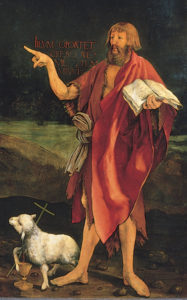
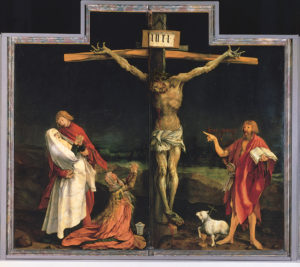
TK: Yes. It is strikingly clear there because you’ve got the singer, who is on the stage, mediating the story: mediating between the outer story and the inner story of the play. Also between that and the audience, which he does explicitly when he says things like, “Here is what she thought but could not say” and he speaks her thoughts. And we’re told explicitly that he is holding a book of the story in front of him much like John the Baptist in the Isenheim Altarpiece by Matthias Grünewald that we discussed earlier. Like John the Baptist, the singer comes from a different time frame, he’s on the stage throughout, he has a book with him, it’s described as a small book, not a big book. But in other ways it is so remarkably similar that you can’t help thinking that Brecht still had this image in mind when he was writing The Caucasian Chalk Circle.

Grunewald_Isenheim1 Grunewald_Isenheim1 John the Baptist

PC: You have spoken about every one of Brecht’s plays being a new experiment, what was the experiment with The Caucasian Chalk Circle?

TK: Well, I think The Caucasian Chalk Circle is interesting in lots of ways, but partly he started off trying to write a play that would be a star vehicle for a Hollywood actress who he had met that might actually get him success in the States. That had been something that had escaped him so far. He always wanted to be a success (that is absolutely clear), he was vain about his own ability. Okay with some justification. But he was frustrated that he couldn’t get through to a bigger audience in the States. So that was maybe where it started off. But then it soon drifts away from that and the actress never took any interest in the play. So it becomes an experiment in thinking about the world after the war. It’s almost the only one of Brecht’s plays that almost ends optimistically. You have to have those ‘almosts’ in there because they’re in the play as well. I mean the singer says we’ll look back on this as ‘the golden age nearly of justice’ or ‘which was almost just’. So that ‘nearly’ sense is very important in the play. It is also an experiment in looking at how a world can pick itself up, or what prospect there is for the future after cataclysmic historical change. That’s what happens in the play, you know, there is a revolution, a war, all of these things going on in the background, and in the end we have a society that is brought back together again; the old order has been deposed. But the new order looks like it is going to be just as bad as the old order was, possibly. What are the hopes for the future? Of course the hope for the future is the child, the symbolically adopted child of the peasant and the returning soldier, and that is the hope for the future.

PC: Does the child represent the connection between the two worlds: the wealthy and the poor?

TK: Yes. The child is a child of aristocracy but has become a child of the people. So that is part of the experiment of the play. I think it is also a quite serious attempt to get back to the basics of Epic Theatre, which is why I think it has the singer and the framework and so many things that we think of as features of the Epic. Because The Life of Galileo had been a little bit, well Brecht himself describes it as retrograde in technical terms: ‘technically a great step backwards’. The Caucasian Chalk Circle is more of an open attempt to engage with the idea of Epic Theatre, and to engage with an audience in that way.

PC: The way you describe it as ‘almost optimistic’. That word ‘almost’ is a good way to sum up his work. His plays challenge the audience with an ‘almost’ and tease you into engaging with them.

TK: You always have to see with Brecht what the alternatives might have been and how it might have all gone wrong (or right, or in any case differently). There is none of the inevitability of the traditional theatre. The traditional ending to comedy is a wedding and The Caucasian Chalk Circle has a happy union of the lovers. But it is not an unambiguously celebratory moment. There is a dance at the end, but it’s a dance that isn’t just a glorious dance of “now the rest of life will be wonderful”. There is a much more threatening undercurrent in the background: the sense that this is also a historical moment which may pass and difficult times may come again.

Brecht talked about this in his acting theory as well. You’re meant to see that characters make choices and it could have gone the other way. That triggers in the audience a reflection on their own choices and what would happen if … I think that is very much the spirit of the ending of The Caucasian Chalk Circle.

PC: It is interesting that Brecht chooses to put the ‘what would happen if …’ on the audience. In the theatrical context he reacts against that question is the actor’s: the magic if of Stanislavski. The “what if…” is swallowed up and digested by the actor and then presented to the audience. Brecht makes an interesting and striking shift away from his theatrical context: refocusing what theatre is.

Summary

  • The singer in Brecht’s The Caucasian Chalk Circle is strikingly similar to the mediating role played by John the Baptist in the Isenheim Altarpiece.
  • The Caucasian Chalk Circle is an experiment in thinking about the world after the war.
  • It is also an experiment looking at what prospect there is for the future after cataclysmic historical change.
  • The ending of The Caucasian Chalk Circle is almost optimistic.
  • Brecht thought that actors should show that characters make choices and it could have gone the other way. That triggers in the audience a reflection on their own choices and what would happen if …

Brecht and Emotion: His ideas on acting

Interview with Tom Kuhn: Part 6

Tom Kuhn is Professor of Twentieth-Century German Literature and Fellow of St Hugh’s College. His main research interests are in political literature in the 20th century. He has worked particularly on Bertolt Brecht, and is the series editor of the main English-language edition of Brecht’s works.

Connections to the GCSE, AS and A level specifications

  • Theatrical style
  • The relationship between actor and audience in theory and practice
  • Key collaborations with other artists
  • Methods of creating, developing, rehearsing and performing

PC: I think it is a fundamental misunderstanding of Brecht to say that there is no emotion in his theatre.

TK: Yes, that’s something that really annoys me.

PC: Could you tell me a little about how emotion was created by Brecht’s actors through the observation of the social condition? How does that differ from Stanislavski’s work on acting?

TK: The distinction that the director Di Trevis made when I worked with her, and the distinction that her actors understood from the work that they were doing, was the distinction between working from the outside in, and working from the inside out. What they understood as Stanislavski’s method was to imagine a psychology of a character, providing a back story in psychological terms for an individual, so that you have an individual psychology in your head and you try to act out of that. Whereas what Di was trying to persuade them to do was to observe the way in which people behave and hold themselves and physically interact. So very much the outside. To observe people as examples of a particular social situation and to act out of that instead. Now of course the two meet in the middle, but I think that is the distinction. So that if you start from the outside you don’t end up with a character that has no psychology, and you don’t necessarily end up with a caricature either or a stereotype, although I think types and caricatures are much closer to the Brechtian understanding and they’re not out of place in Brecht’s theatre at all. Whereas they are completely out of place in a Naturalist theatre. And if you start from a psychology then you may also start to discover the social conditions which create that psychology. So the two can meet, but it is those very different starting points which seem to be the key to the work that she was doing. Does that make sense?

PC: Absolutely, it makes sense. I think that the distinction is clearest with earlier Stanislavski theory, the ones that had such an influence on Lee Strasberg’s Method acting. However, it is fascinating to see the similarities with Stanislavski’s later ideas for physical actions being the starting point for character. His idea was that the actors started with the observable, outside actions, even before reading the text. But like you say the distinction is clearest in the outcomes: Stanislavski used observable, outside actions so that the actor could inhabit the role. Brecht used observable, outside actions so that the actor could capture an accurate social condition, even a stereotype, as long as it served the social/political purpose of the play.

TK: Yeah, but I think there is a definite a distinction. I don’t think the difference is that huge and obviously both men shifted their ground. The idea that there is such a big conflict between them is strategic for Brecht. He wants to be different from Stanislavski. What is more, by the time of Brecht’s work with his newly founded Berliner Ensemble at the beginning of the 1950s, Brecht was a suspect thinker for the authorities of the German Democratic Republic. They needed to think of themselves as followers of the Russian model, and they even staged a big Stanislavski conference in Berlin with part of the motivation being to knock Brecht into shape and get him to toe the line. Therefore, in the context, insisting on the difference became very important, whereas in another context that might not have seemed so important.

PC: And this desire to be different influenced Brecht’s ideas on acting.

TK: Yes. Brecht is always warding off the psychological. His plays are full of spilt characters and slightly caricatured characters. Quite the reverse of psychologically realistic characters. He quite liked comic actors as well, because they don’t get caught up in the psychology of their characters so much. They are much more likely to act slightly over the heads of their characters, to insist on a distinction between actor and character. He loved Charlie Chaplin because he demonstrated the little man rather than being the little man. And that idea that there is a divorce between the actor and the part he’s playing is quite important for Brecht’s ideas. Ernst Busch is one of his favourites, and Helene Weigel of course. Both gave us archetypal demonstrations of the sorts of people they are playing, rather than becoming those people. It’s much more about showing than being. I think part of that comes again from this attention to external movement, behaviour, posture and things like that as an expression of something social rather than just of something psychological.

PC: Did he achieve this by getting his actors to observe people?

TK: Yes. Getting back to the pictures, Brecht’s files for his plays are full of pictures, mostly cut out of newspapers, and press photographs of the sorts of people he has in mind when he is writing. So amongst the materials for The Caucasian Chalk Circle he has a whole page stuck in an album of pictures of women refugees with babies or children slung over their shoulders. There is an archetype: of the woman with a bundle on the run; and the actress playing Grusha has to become that, rather than being a completely singular individual. You see them again crossing the Mediterranean. Brecht would have been writing about refugees again. Grusha is a refugee.

PC: That idea of collecting pictures is exactly the kind of task that students are encouraged to do in preparation for their portfolios. How did these photographs have a direct impact on actors like Helene Weigel?

TK: Well, for example: Brecht assumes that Helene Weigel had the image of a woman after the bombing of Singapore (Singapore Lament, Life Magazine, 23.03.42, photo license pending) in her mind when creating Mother Courage’s ‘silent scream’. It is a picture that he kept in several contexts, in his published collection of war time photographs – War Primer (http://goo.gl/r91UUf) and in his work journal in a different version.

Summary

  • Brecht wanted his actors to observe the way in which people behave and hold themselves and physically interact.
  • Actors should use people as examples of a particular social situation.
  • Characters can still have a psychology if you start from the outside.
  • Stereotypes and caricatures are not out of place in Brecht’s theatre.
  • Brecht wanted to position his ideas as different from Stanislavski.
  • Brecht liked comic actors and admired Charlie Chaplin because they don’t get caught up in the psychology of a character.
  • Brecht kept files and notebooks filled with photographs that influenced his productions.

Brecht: Verfremdung is a Funny Word

Interview with Tom Kuhn: Part 5

Tom Kuhn is Professor of Twentieth-Century German Literature and Fellow of St Hugh’s College. His main research interests are in political literature in the 20th century. He has worked particularly on Bertolt Brecht, and is the series editor of the main English-language edition of Brecht’s works.

Connections to the GCSE, AS and A level specifications

  • Theatrical purpose
  • Influence
  • Significant moments in the development of theory and practice

PC: Brecht took many ideas from historical theatre conventions and experimented with them in his own work. Many of the conventions have a connection with this elusive and somewhat confusing term: Verfremdung. My definition is: the process of moving an audience from identification to detachment. What do you think of this definition?

TK: Yeah, using identification is perhaps a little over-stating it. But I don’t think it is completely wrong. It is rather more from sympathy than from empathy. I would say that Brecht is quite wary of identifying with a character. But yes it is taking you from something recognisable to moving outside. Or the other way round as well: showing you something which seems completely strange and then suddenly you recognise things and think, “hang on, this isn’t different to the world I know.”

But Verfremdung is a funny word. People make the mistake of thinking Brecht is a systematic thinker, a philosopher, but Verfremdung is a word that he starts using before he has actually entirely decided what it means, and then he gradually tries it out. It is experimental again. How am I going to make this word do some work for me? And then eventually, and this is terribly important, it starts to crystallise absolutely around social phenomena. People also sometimes forget, when they’re talking about Brecht, with all this talk about epic theatre and songs interrupting the action and being able to see the lighting in the theatre and all of those sorts of things, they forget that the whole purpose of this is to analyse social phenomena. Brecht is interested in politics and society, so to call a modern production of something ‘Brechtian’ simply because it uses some of those outward characteristics is really missing the point, unless it has that social/political edge. That was what it was all about as far as he was concerned. So Verfremdung came to mean not just that alternating experience of sympathy and distance, of the strange and the familiar, but was absolutely a path to understanding the social condition that we are in, the social circumstances of his characters and actions.

Summary

  • Brecht wasn’t a systematic thinker or a philosopher.
  • Brecht started using the word Verfremdung before he had decided what it meant for the theatre.
  • It came to mean understanding the social condition by moving an audience from something they recognise to a state of detachment. Or the other way around.
  • The whole purpose of Verfremdung is to analyse society.
  • Theatre that is described as ‘Brechtian’ must have a social/political edge.

Brecht’s Dramatic Structure and Design

Interview with Tom Kuhn: Part 4

Tom Kuhn is Professor of Twentieth-Century German Literature and Fellow of St Hugh’s College. His main research interests are in political literature in the 20th century. He has worked particularly on Bertolt Brecht, and is the series editor of the main English-language edition of Brecht’s works.

Connections to the GCSE, AS and A level specifications

  • Key collaborations with other artists
  • Methods of creating, developing, rehearsing and performing
  • Theatrical style
  • Significant moments in the development of theory and practice

PC: What were Brecht’s ideas for structure and flow?

TK: If you were to ask another, more conservative early 20th century theorist for an account of drama I suppose they would give you a vision of classical drama with an exposition, a development, a crisis and a dénouement. And that sweeps you through as an emotional experience to probably some sort of catharsis at the end. Brecht wants to interrupt all of that and make that impossible and he does it in big ways and in little ways. The Caucasian Chalk Circle gives that wonderful example of a big way saying, “we’re going to interrupt the story here and give you the back story of this other character, Azdak, whose relevance at this point is completely obscure.” That’s a big interruption in that flow. But there are also little ones simply when characters step out of character, step forward and address the audience directly. That is also a sort of break in the flow, giving us a different perspective on events.

PC: So there were multiple perspectives in his plays?

TK: Yes. Brecht liked Chinese art, as well as late-medieval/early Renaissance art, and one of the things he liked about Chinese art was that it doesn’t give you a single perspective; Chinese art tends not to give a single focal point or a point of view. Instead you get these landscapes with multiple perspectives. Brecht quite liked that, and perhaps you can understand some of the interruptions in his plays, for songs and other character’s points of view, as a sort of perspectival interruption in the action. He wanted us to suddenly see something from a different point of view. A good example in Mother Courage is when her son is executed and she has to deny that she recognises him. It is a completely heart-rending moment, a very emotional moment. People sometimes think there is not much emotion in Brecht. They are wrong. There’s loads. This is a very emotional moment, but then immediately afterwards we get a scene that changes the point of view entirely. Mother Courage is trying to get back into business, so rather than carrying that emotional charge forwards, the emotional charge is broken off and we suddenly see her life from a different point of view. Brecht enables us perhaps to reflect on what has happened in a more intelligent way than we would do if we were emotionally caught up with it. So those emotional moments aren’t carried forward, they are not intensified by the action, they are rather interrupted and broken off by it.

PC: How about medieval tapestries with their collection of stories on one fabric?

TK: Absolutely. Late medieval religious art was very important for Brecht. He was brought up in Augsburg which is a predominantly Catholic but also a Protestant town. He was of mixed parentage himself so he had access to both but was brought up as a Protestant. So he saw the Catholic church from outside which is interesting.

PC: How did Brecht use visual art to trigger ideas for productions?

TK: Caspar Neher is the childhood friend and collaborator who developed the whole look of the Brechtian theatre. What we think of as the Brecht Curtain – the light half curtain – Brecht himself called it the ‘Neher Curtain’. You really need the two of them together when you think about the visual image of what Brecht’s theatre looks like. Neher worked on nearly all, maybe 90% of Brecht productions until 1933. Then Neher stayed in Nazi Germany and continued to work as a director, and Brecht of course left. When he returned to Switzerland, the first person he got in touch with was Caspar Neher. Neher is absolutely central.

Summary

  • Brecht doesn’t want his audience to be carried through a story on an overall emotional journey. He wants to make catharsis impossible.
  • Brecht wants to present emotion but then interrupt it.
  • Brecht was influenced by multiple perspectives in Chinese art and late medieval art.
  • Brecht’s childhood friend and designer, Caspar Neher is absolutely central to his idea of theatre

Brecht’s Ideas for a Post-War European Theatre

Interview with Tom Kuhn: Part 3

Tom Kuhn is Professor of Twentieth-Century German Literature and Fellow of St Hugh’s College. His main research interests are in political literature in the 20th century. He has worked particularly on Bertolt Brecht, and is the series editor of the main English-language edition of Brecht’s works.

Connections to the GCSE, AS and A level specifications

  • Innovations
  • Significant moments in the development of theory and practice
  • Social, cultural, political and historical context
  • Influence
  • Use of theatrical conventions

PC: Can we talk about Brecht’s Short Organon, which is the most distilled collection of his ideas for the theatre?

TK: Yes. So, when the war ends he starts to think much more seriously about returning to Europe. That’s when he formulates his ideas in this most complete way. I think that is because he has the sense that culture has been derailed in Europe. There is a need to rebuild the theatre houses physically but also to rebuild the content of the theatres. He wants to put his mark on that process, and so the Short Organon is his calling card: “Look. I’ve got some ideas, these are my ideas, lets do it this way.” That’s why he formulated it all so clearly. That is all it is, if it hadn’t been for those circumstances he might not have written his ideas in such a way. We do him a disservice by taking the Short Organon out of that context and treating it as though it was somehow a Brecht bible. It’s much more a template in response to the conditions of post-war European theatre.

PC: Does the importance of his context and circumstances pose difficulties for replicating his ideas?

TK: Yes. It is very hard to think in terms of replication, simply because we can’t go back to that historical moment. Some of the basic outward features of Brechtian theatre – the visible theatre apparatus, changing the scene in such a way that we can see, and actors stepping in and out of role, they are pretty commonplace. Anyone who goes to anything serious in the theatre would probably see an example of that, maybe even in a production of Ibsen and certainly in lots of other theatre productions. That is partly because Brecht just won that argument and nobody really tries to create a complete illusion of reality any longer. They do in film, although film goes in both directions in a quite confusing way and is difficult to generalise about, but some film tries to just create the world as perfectly as possible. No theatre really does that any longer. This is partly because films supplanted that function of the theatre and partly because Brecht showed us a different way of making theatre. So then, if students already have that sense that if you go to the theatre of course you know you’re in the theatre and you don’t have an illusion of reality, then Brecht doesn’t seem anything special or particular, you can’t replicate the historical impact of Brechtian theatre, simply because it has become the new normal, it is just what you see all the time anyway.

PC: I think a lot of young people don’t have that experience of the theatre. What they do have is the experience of the cinema that you talk about. So Brecht still has that feeling of something quite revolutionary. That’s why his ideas are so attractive to teachers: they don’t need a lot in the way of resources and they challenge young people be more analytical and reflective about the process and content of their work.

You mentioned the basic outward features being quite commonplace would you also agree that lots of his ideas were in existence in Ancient Greek theatre, Büchner’s Woyzeck and Shakespeare?

TK: Yes. It is indeed all there in Shakespeare. But everything is all there in Shakespeare! Shakespeare has plays within plays, he has prologues, he has singers, as it were at the front with their fingers pointing, that say “Oh for a muse of fire …”: all of these sorts of things point out the particular constraints and potentials of theatre:

Can this cockpit hold

The vasty fields of France? Or may we cram

Within this wooden O the very casques

That did affright the air at Agincourt?

The beginning of Henry V has the same sort of self-conscious reflection that Brecht is saying: “Let’s make it all clear that we’re in a theatre and this is pretence.”

Brecht is eclectic, he draws on the idea of chorus in particular from the Greeks and he draws on the early-modern, Shakespearean theatre. What he doesn’t want is the 19th century. Woyzeck is a bit of an exception in that it doesn’t look like other 19th century plays, and of course Woyzeck is an unfinished play and there is an extent to which you can project on to it whatever you want. So that when the play was rediscovered at the end of the 19th century, first of all the Naturalists thought that they were following Büchner, then the Expressionists thought that they were following Büchner, then Brecht thought that he was following Büchner. They all took what they wanted from Büchner.

PC: And it was the only external text referred to by Antonin Artaud.

TK: Yes. I think a lot of Germans and especially Brecht thought that it was a way of saying, we’re not being Schiller, and putting down a marker: we’re not trying to do Schillerian theatre here. I think Büchner is wonderful, and Woyzeck a great play. We’ll never know how much of the sort of fragmentary and broken nature of the text (which obviously appealed to Brecht, with his idea of the scenes not being fluidly arranged in a compelling plot) how much of that is down to the fact that he didn’t finish it, and how much of it is down to a really rather revolutionary dramatic imagination?

PC: It is almost the opposite of the theatre maker who has the inclination to write their thoughts and ideas down. Do you think that Brecht wished he could have been that enigmatic?

TK: No. I think, for Brecht, the alternation between rationalising reflection and much more unfettered creativity, that back and forth, is an essential part. You can’t imagine the one without the other. But Büchner was also a young man, he wasn’t really practiced in his art, he didn’t know what worked so he produced things that didn’t work. That didn’t work then. Which later generations discovered as a revelation for the modern theatre, it is a bit of a historical accident. A wonderful historical accident.

PC: It is interesting to think about that in the secondary school classroom: drama teachers aim to cultivate the environment for creativity and reflection, the back and forth. But they also believe that young people can challenge ideas of theatre by creating things that seem, at first, not to work.

Summary

  • Brecht’s Short Organon a template in response to the conditions of post-war European theatre.
  • Nobody really tries to create a complete illusion of reality in the theatre any longer.
  • The lack of illusion in modern theatre is because Brecht won his argument but also because film and television serve that purpose now.
  • Brecht’s ideas for theatre can still seem revolutionary for young people who are more exposed to film and TV than theatre.
  • Brecht’s ideas were heavily influenced by Ancient Greek theatre, Shakespearean theatre and Georg Büchner’s Woyzeck.
  • Brecht was eclectic and drew from almost everything, apart from 19th century Naturalism.